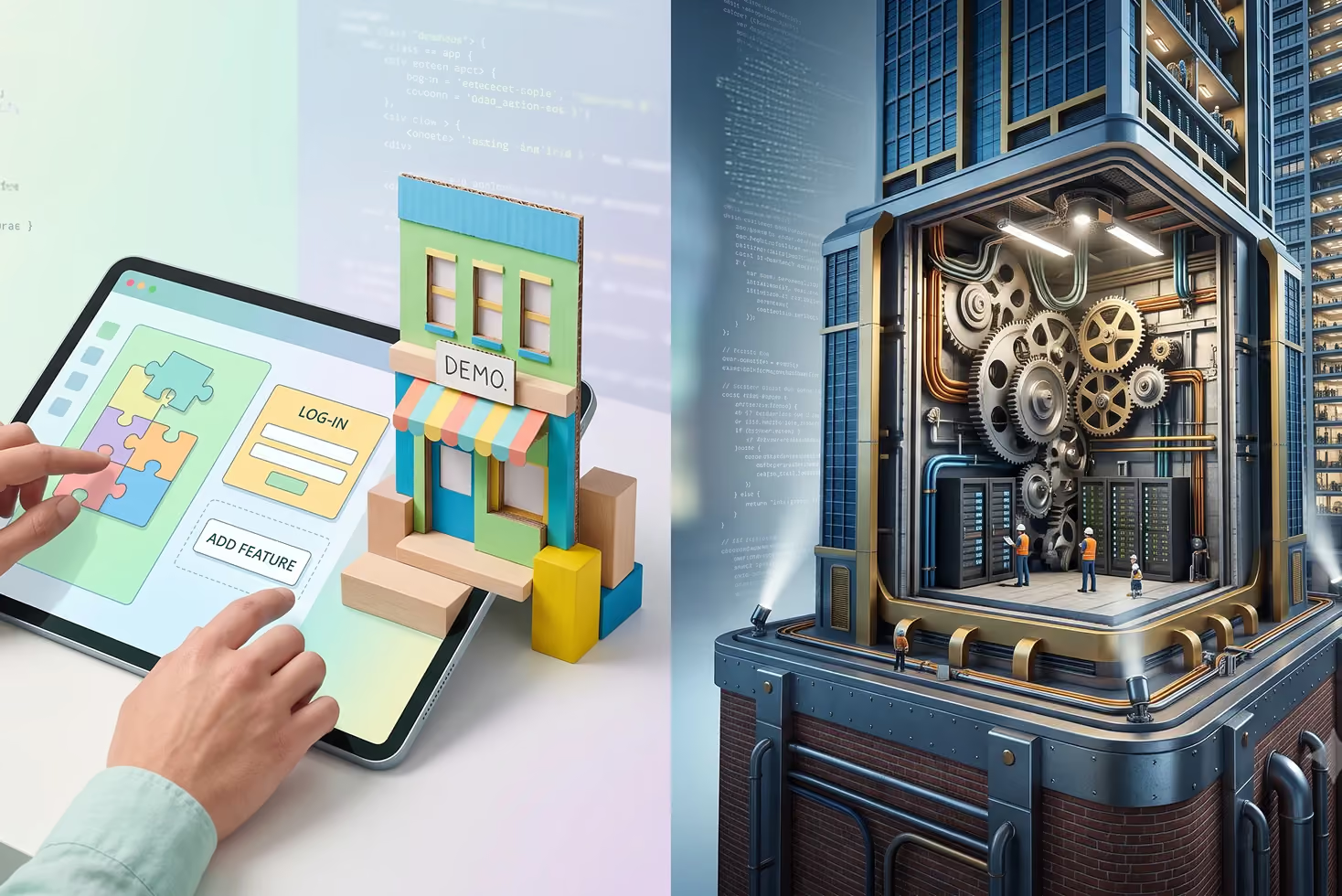
No-code is genuinely good at one thing: getting an idea out of your head and into something clickable, fast and cheaply. It is a poor place to run a real business from, because the things that turn software into a business, scale, security, sensible data design and real usability, are exactly the things no-code hides from you until they break. A demo and a business are not the same deliverable, and no-code is built for the first.
The category is large and growing, so this is not a fringe worry. Gartner valued the low-code market at 26.9 billion dollars in 2023, growing about 20 percent a year (Gartner, 2022), and expected that by 2026 at least 80 percent of low-code users would sit outside formal IT departments (Gartner, 2022). In plain terms, more and more of the software businesses depend on is being built by people who are not engineers. That is fine for a prototype and risky for a product.
Is no-code app development good enough to build a real product?
For proving an idea, easily. For running a business on, usually not, and the reason is structural rather than a matter of effort. An academic review of low-code and no-code platforms in 2024 found they support small to medium workloads well but hit real obstacles at serious scale: runtime overhead, weak extensibility, integration difficulty and vendor lock-in (Jangam, 2024). Those are not bugs you can fix. They are the trade-off you accepted when you chose a platform that handles the hard parts for you by not letting you near them.
What is no-code actually good for?
Speed and validation. If you want to test whether people respond to an idea, get a working demo in front of users, or stand up an internal tool that will never need to scale, no-code is an excellent choice and often the right one. Using it to prove a concept before spending real money on custom development is smart. The mistake is not starting with no-code. The mistake is assuming the thing you validated is the thing you can grow.
Where does no-code hit a wall?
At exactly the point your idea starts working. Growth is when the limits that did not matter for a demo start to matter a great deal.
The ceilings you meet as usage grows:
- Performance that degrades as users pile on
- Integrations the platform simply does not support
- Vendor lock-in on your data and your logic
- Costs that climb with every user
- Security and governance you cannot fully control
The bill for shortcuts taken early has a name. In one survey, 69 percent of IT leaders called technical debt a major threat to their ability to build new things, with organisations spending on average about a third of their IT budget servicing it, rising to 41 percent at larger firms (OutSystems, 2021). A no-code build that has outgrown itself is technical debt you cannot even see the code of.
What does a no-code build get wrong that you can’t see?
The parts that do not show up in a demo, which are the parts that matter. A client came to us with a booking system for selling services. They had never really defined what a minimum product was, so they had added, and added, and added. The result was an enormous application with about a hundred items in a single menu, none of it grouped or organised. There was no thought about how anything connected on the back end. The infrastructure had been chosen by saying yes to whatever the tool recommended. And there was no usability thinking at all.
It was a huge app with a vast number of features, and close to useless to anyone trying to actually use it, with security exposure sitting under the surface for anyone who looked. That is the trap in one example. No-code makes adding things so easy that nothing stops you building something big, and big is not the same as good. It removes the friction that would otherwise have forced someone to ask whether any of it should exist, and that friction is where a lot of the value of proper development lives. AI-assisted and low-code building make this worse, not better: in a 2024 survey, 62 percent of professionals said AI-assisted development introduced security and governance concerns (OutSystems, 2024). That survey came from a low-code vendor, so read it with that in mind, but the direction fits what we see.
No-code vs custom development: should you ever start with no-code?
Yes, deliberately and with an exit in mind. The real no-code vs custom development question is not either/or, it is when to switch. Use no-code to prove the idea, then plan to rebuild properly on custom foundations once you have shown the case, because the demo was never meant to be the business. The trouble comes from treating the prototype as the product and scaling it until it collapses under its own features. Start with no-code to learn cheaply. Move to real software once you know what you are actually building.