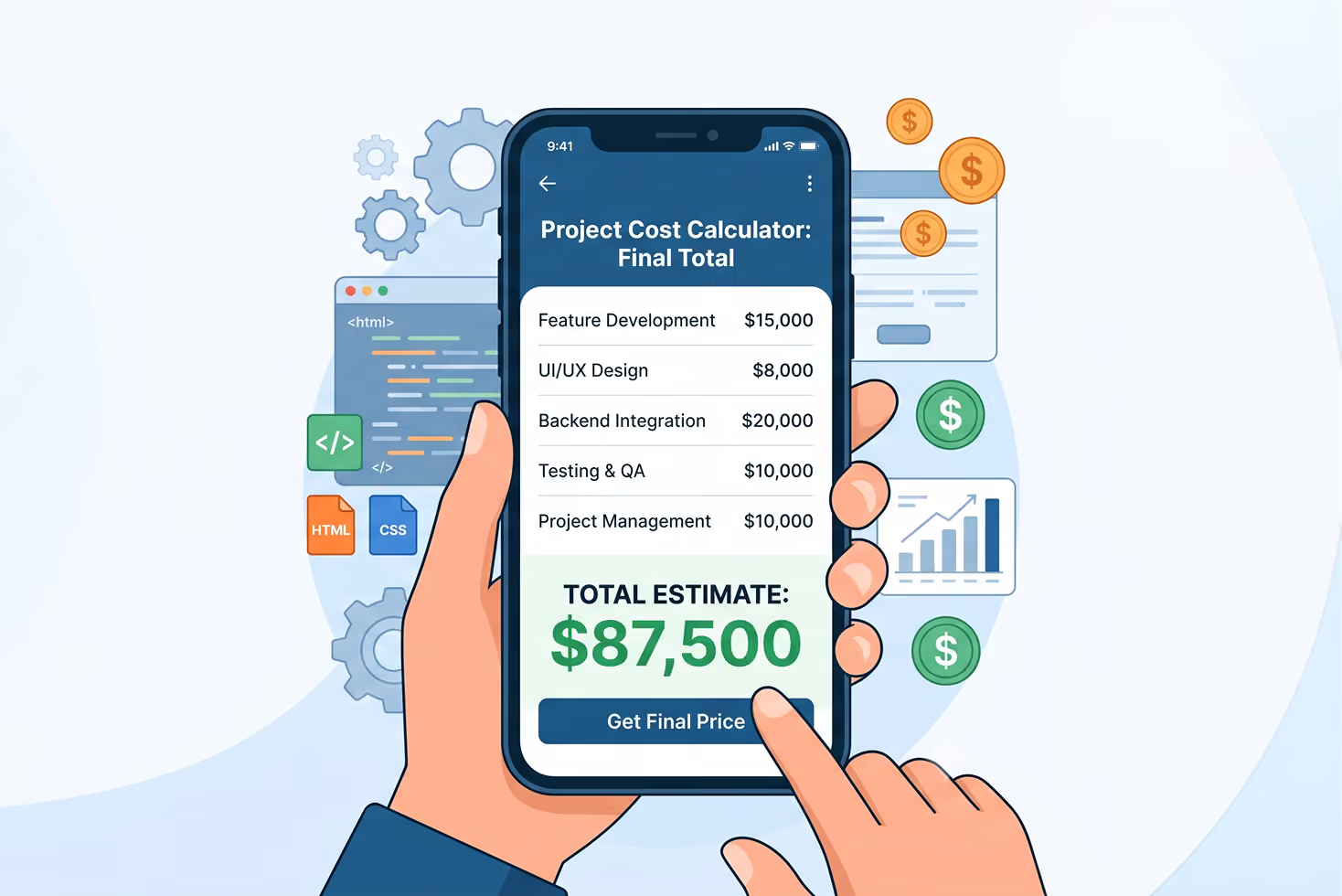
Most people asking this have already collected three quotes that disagree by a factor of ten, plus a lot of "it depends". So here is the straight version. A piece of software worth building rarely costs less than about £5,000 to £10,000. A genuinely useful app for a business usually lands somewhere between £30,000 and £100,000, and the most involved products run well past that. The wider truth, and the one that saves you money, is that in 2026 the cost is driven by the value of the thing you are building, not by a day rate.
That single shift changes how you should think about the whole spend, so it is worth walking through properly.
So, how much does it cost to build an app?
Here is the shape of it. UK agency guides put a simple app at roughly £10,000 to £40,000, a mid-complexity build at £30,000 to £70,000, and a complex or enterprise product from £75,000 to well past £200,000 (Appwrk, 2025). Treat those as what agencies quote rather than independent measurement, because everyone publishing them sells development. They are still a fair map of what app development costs in the UK.
Running software is not free, which is the part most people forget. Budget 15 to 25 percent of the original build cost every year to keep it secure, current and alive (Appwrk, 2025). A £60,000 build is really £60,000 plus roughly £9,000 to £15,000 a year.
Why won’t anyone give you a straight number?
Because a quote means nothing without the scope behind it. A simple app with a few screens and a login is not the same animal as a platform that takes payments, syncs data across devices and has to stand up to a security review. Ask two developers to price "an app" and they each picture something different, so the numbers diverge. Pin down what the thing actually does and the range collapses to something useful.
Has AI made building an app cheaper?
Yes and no, and the nuance is where the money is. AI tooling has made the first stretch, zero to one, dramatically faster. In a controlled study, developers finished a coding task 55 percent faster using an AI assistant (GitHub, 2022), though that was an isolated, greenfield task rather than work on a real, messy codebase.
On real systems the picture flips. In a 2025 randomised trial, experienced developers were actually 19 percent slower using AI tools on mature codebases they knew well, even though they believed they had been about 20 percent faster (METR, 2025). Google’s DORA research found the same pattern at team level: as AI adoption rose, delivery throughput and stability tended to dip slightly, even while most developers felt more productive (DORA, 2024).
So AI gets you a working prototype quickly and cheaply. What it does not do is climb the four or five rungs left between a prototype and production software: security, information security, scalability, sensible infrastructure and all the non-functional work that never demos well but decides whether the thing survives real users. Skip those and you are not saving money, you are deferring the bill. Poor-quality software cost the US economy an estimated 2.41 trillion dollars in 2022 (CISQ, 2022), most of it exactly this kind of deferred cost.
Where does the money actually go?
Not where people expect. The visible part, writing the features, is often the smaller half. The cost sits in getting the requirements right, designing something people can actually use, wiring up the infrastructure properly, testing it, securing it and maintaining it. Large IT projects run on average 45 percent over budget while delivering 56 percent less value than predicted (McKinsey and University of Oxford, 2012), and it is almost always the invisible work that was underestimated, not the feature list.
This is also why who builds it matters more than it used to. The people you want using AI to build production software are senior engineers who can tell when the machine is confidently wrong. A fresh coder with an AI subscription can produce something that looks finished and is quietly a liability. You are paying for judgement, not keystrokes.
How much should you spend on an MVP?
Less than you think, until the product is proven. If you are still testing whether people want the thing, spending several hundred thousand pounds is a mistake dressed up as ambition. Build the smallest version that proves the case, then invest once the demand is real. Nothing serious tends to come in under about £5,000 to £10,000, but the ceiling on a first version should be set by what you need to learn, not by everything you can imagine.
The exception is when the business case is obvious and the return is large. If a piece of software will clearly save or make you a sizeable sum, the absolute cost matters far less than the return, and under-investing to save a few thousand becomes the expensive choice. That is what "value-driven, not day-rate" really means. The right question is not "how much does an app cost", it is "what is this worth to us, and what is the smallest spend that gets us there safely".
Check out how much app development actually costs in the UK.